
Post & Present
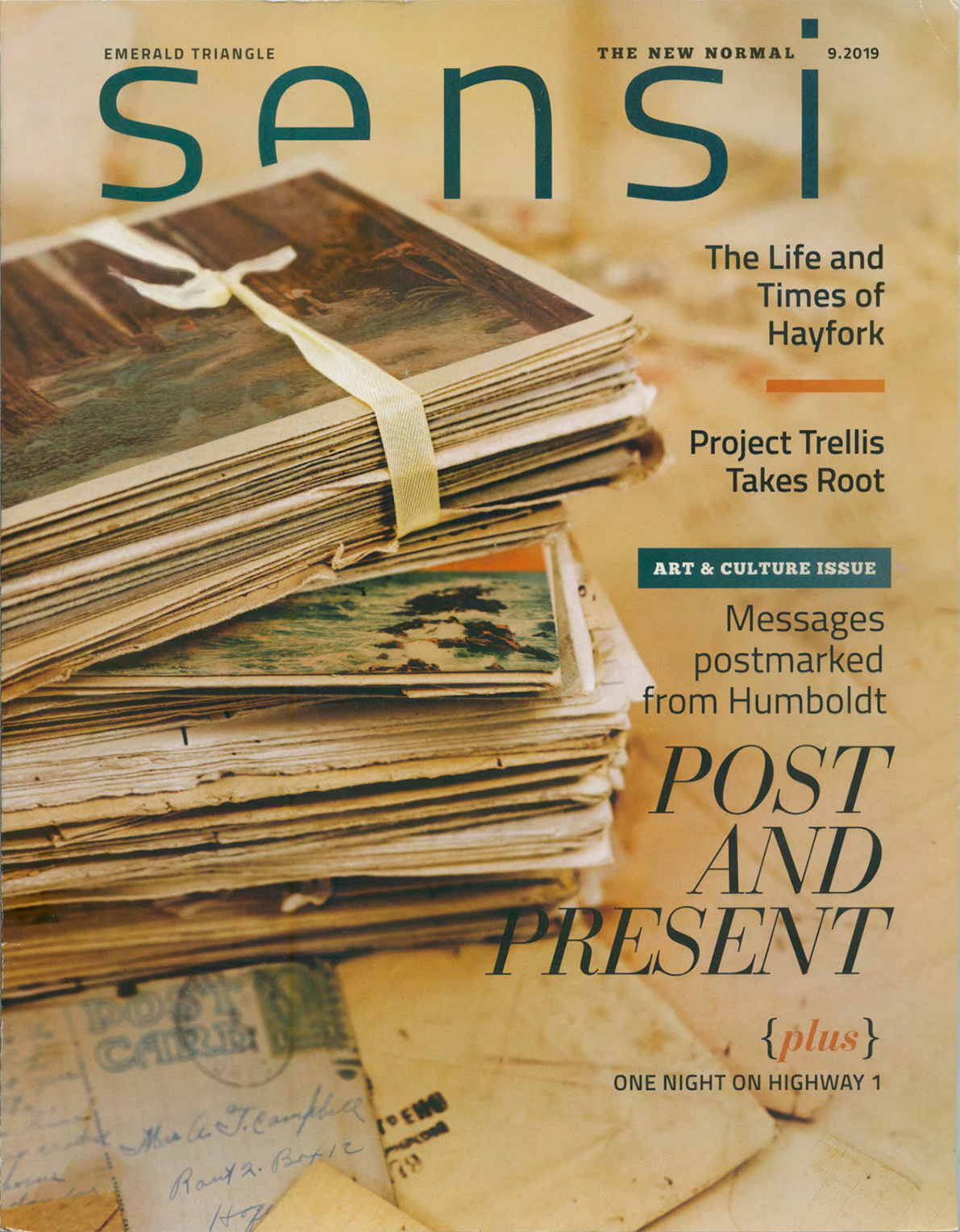

Editor’s Note: The culture Humboldt County has been preserved over time through stories and history, often tinged with folklore. A region known for its ancient trees, off-the-grid homesteads, secret gardens, and dramatic beauty does not fit easily into a single frame. In an effort to study and appreciate this wild place, Eureka resident Steve Lazar has found an interesting niche in collecting historic postcards from Humboldt County, some mailed locally between friends and loved ones; others sent across the country by locals and visitors alike. While the postcard images range from the magnificent to the ordinary to the politically incorrect, Lazar has found a surprising connection with these—often hard to decipher—on the flipside of each postcard. Since 2004, Lazar has worked as a Humboldt County planner and in recent years, helped to craft, pass, and implement Humboldt County’s Marijuana Land Use Ordinance. Kindling a passion for local geography and history since moving to Humboldt in 1995, he also currently serves as Vice President of the Humboldt County Historical Society, and often shares images and stories from his postcard archives with the general public. Handmade personal reproductions of his cards can be purchased locally with proceeds that support ongoing efforts to digitize local historic images.
—Nora Mounce
POST AND PRESENT
A Humboldt County planner finds meaning in past and place.
by STEVE LAZAR
MESSAGE AS MEDIUM
The current postcard format we are all familiar with can be traced back to the following key changes in US Postal law: the reduction of postage from 2¢ to 1¢ for mailing privately produced cards (1898), allowing private cards to bear the label of “POSTCARD” (1901), and the introduction of cards with a “divided back” allowing space for messages next to the mailing address (1907). Collectively, these new developments revolutionized the medium, helping to usher in the “Golden Age of Postcards.” Production of cards skyrocketed during the first decade of the 20th century and popularity kept pace as cards soon proved an affordable and effective means for communication and collecting “views” by both locals and visitors alike. By 1907, over 677 million post cards were being sent through the U.S. mail. With an estimated U.S. population of 88.7 million at this time, this amounts to between 7–8 postcards sent annually by each woman, man, and child. By 1913, nearly a trillion cards were mailed each year.
Over a decade ago, I began collecting historic postcards of Humboldt County. Immediately fascinated by the nostalgic portal they provide into local history, my collection grew quickly. The hobby-turned-obsession soon resulted in development of a homemade website known as THEHUMBOLDTPROJECT.ORG, and at its height, the hunt for new postcards was nothing short of an addiction. These days I am mostly “on the wagon” (off eBay) and focused on finding ways to share and interpret thousands of cards—now returned home within the community.
As far as souvenirs are concerned, there is almost nothing more iconic than the postcard. Messages found on postcards reveal timeless themes linked to visitor experiences in our region. The struggle of postcard authors to put into words what they’ve witnessed, especially during their voyage “behind the redwood curtain,” provides entertaining insights on an assortment of topics. On the other hand, cards used for local correspondence between residents reveal glimpses of regional culture and lifestyles, seasonal and long-term changes, and our unending need for feedback and stimulation in all its forms.
It’s only natural that a postcard’s central image or scene captures our initial attention. However, after years spent voyeuristically reviewing thousands of postcards mailed from Humboldt County, I have developed a real fondness for the messages on the backs of postcards that often surpasses my interest in the front of the card. The following transcriptions of personal notes or messages are taken from locally sent cards in my archives. Selections have been chosen carefully and are intended to serve as lasting examples of this artful early medium for ephemeral communication.
The inadequacy of using language and/or photography to convey the visitor experience of the redwoods is illustrated in a charming message from this 1930’s era postcard:


“Am writing this by the campfire which accounts for the scrawl. The Giant Redwoods of Calif are too wonderful and full of awe-inspiring bigness [sic] to describe. They gave me many a thrill not to mention the chills which would play tag between extremities. These views might convey an impression but they are no comparison to the actuality. We had two camps in the big timber—How does it feel? No use to attempt an intelligent description but I never felt so small and insignificant as when among and surrounded by these monsters in the Land of the Giants. Amen.”
SOME NEAR HAIKUS
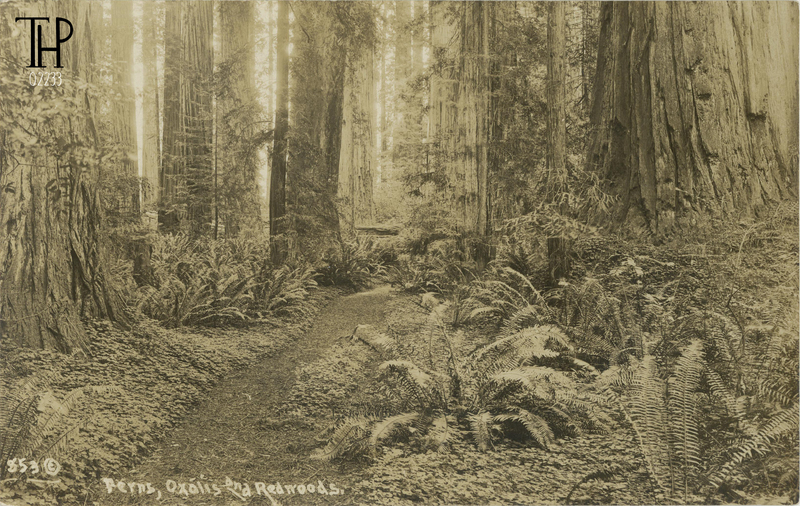
Some of the best cards say a lot with a little. On a classic sepia-tinged photo of the redwoods from 1937, before posting her note to a Miss Jean Johnson in San Francisco, author Louise writes simply:
"Dear Jean!
Climate Hot!
Ride Glorious!
Relief great when
I reached Lane’s Red-
wood Flat—lovely
spot! Gratefully
Louise A. Steiner”

Another card sent to Washington D.C. from Eureka in 1937 depicts sportfishing at the Klamath River mouth near Eureka. Whether cheeky or sincere (or both), the simplicity of the message, "Far Enough North.", is powerful.


Fishing boats at Klamath River mouth - Patterson
THP no. 02590


HEAVY HITTERS
The imagery and feeling in some messages takes your breath away. A card from the late 20’s describes an early incarnation of the Redwood Highway, in its route along the south fork of the Eel River. Near the end of the message the authors melancholy is palpable:
"...We are breaking camp now. –and
hate it. I have not yet resolved an explan-
ation, but I dread going back to the
office grind. Myrtle suggested
that we stay here all winter and that
I get work splitting grape stakes
out of redwood. I slept on the
mountain top again night
before last, without blankets, and
with a small fire which I had to
wake up and replenish at inter-
vals –in another last try for deer, but
no use. Had hoped to send you some. M&R”
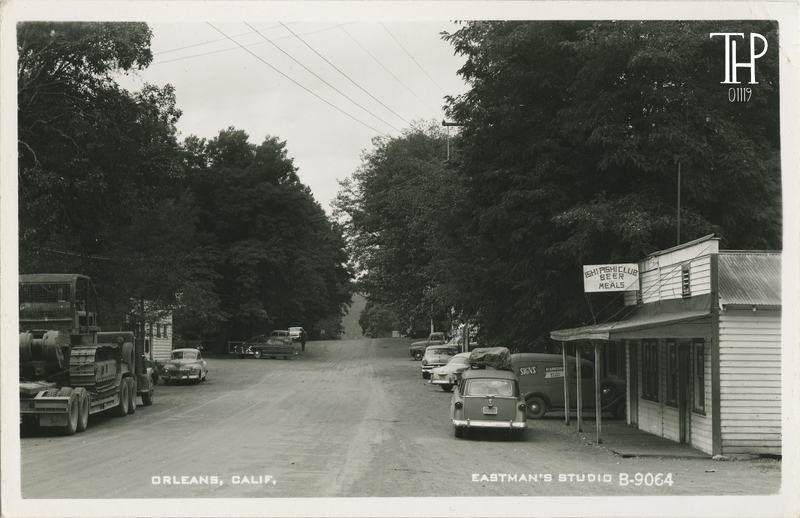
In another card, though the sender’s penmanship and grammar leaves something to be desired, “Jim” still manages to charm the pants off you in his message sent from Orleans to Petaluma in August of 1963:
“This is the full size of Orleans. The town I have been raving about. All of my friends are here...and every one really are swell people. Am going to a real country dance in the school house Sat eve. They say that they close at 12:30 so they are too drunk from then on. Expect to be here for a couple of weeks. Am going wild blackberry picking tomorrow if I have luck will can you a few pints. Love Jim”

LEAVES OF THREE, LET IT BE!
On August 3, 1959, a card depicting patrons lounging poolside at the White Motel in Garberville was sent from Eureka to a guest at the motel, 60 miles south. Reading the flipside, we’re granted a brief window into the possible suffering of a Mrs. Campbell—perhaps, she regretted a recent visit to one of the Eel River’s many wonderful swimming holes...and/or just wished she had learned sooner how to identify poison oak.


“Hello,
This is name
of poison oak
spray "Rhulispray"
made by
Lederle”
Sincerely,
Mrs. Chas. Hodgkinson”
THE OLD HIGHWAY
No theme is more documented and widespread than the experience of traveling along the “Redwood Highway.” Be it a journey over the mountain passes and river canyons of Trinity and Siskiyou country (Highways 299 and 199) or weaving through dense redwood forests (in Del Norte County or Southern Humboldt) with their impossibly large trees, travelers are inundated with scenery that never quits. Today, cars can still travel ‘The Redwood Highway.’ Portions of it have been expanded into U.S. 101 while other segments bypassed by subsequent highway alignments remain available as alternate scenic routes.
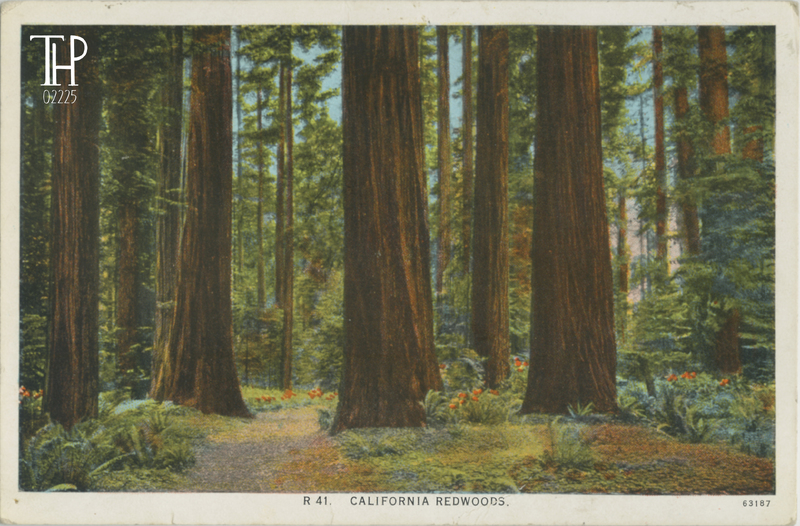

Sent from Myrtle Creek Oregon home to Washington State in 1928:
“Dear Son. This is the best part of the trip. Lovely drive, but you half [sic] to be at the wheel all the time because it is so crooked. Will arrive home about Wednesday eve if we do not stop to(o) long in Portland. Every thing is lovely / Lots of Love / Dad & Mother”
A card addressed to Mr. L.H. Morris in Plymouth, Indiana in 1963 speaks to the steady thrum of “progress” and attachment to the old highway being bypassed:
“We were really impressed with these (trees). They are building new roads which will ruin the feeling of the trees but are keeping some of the old road as a scenic drive! M & B”


COASTAL SPLENDOR
A charming color lithographic card depicts Scenic Drive near Luffenholtz Beach and Humboldt County’s famous surf spot, Camel Rock. Sent from Arcata to Crossville, Tennessee in 1928, the author’s message captures the prominence of local timber and dairying. Camping and searching for rock fish before heading to the hills paints a lovely picture:
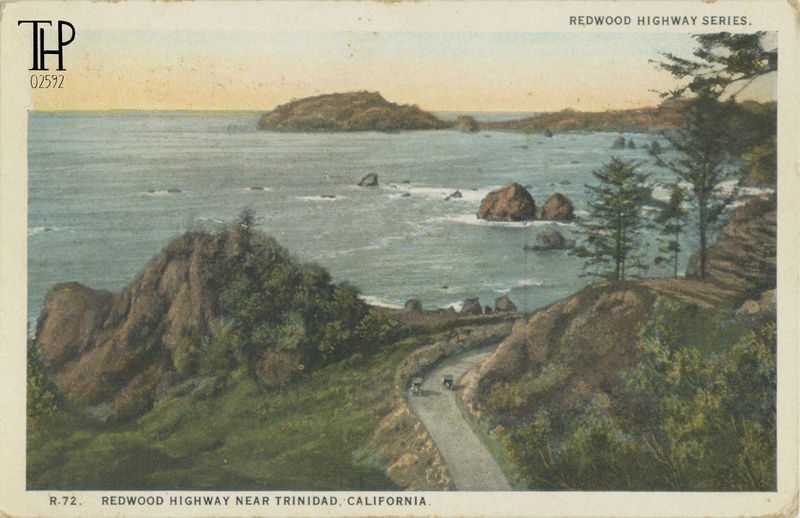

“Arcata, Calif.
July 27, 1928
1:30 p.m.
Dear Papa
We camped near this place in the picture
and went fishing
down in the rocks. We
went through a creamery and a barrel factory
today and are going to Willow Creek in the
mountains tomorrow. With love, Ethel”
POST SCRIPT (P.S.)
As during the heyday of postcard production, the public’s interest in deltiology, the study and collection of postcards, has grown dramatically in the last few decades. A phenomenon experiencing its own Golden Age, deltiologists reveal timeless insights on the 20th century, an era where the slow pace of the written word created artifacts to appreciate with the naked eye and human touch.
Visit THEHUMBOLDTPROJECT.ORG or sensimag.com to see more postcards from Lazar’s collection.